01
Home
02
Services

03
Cases

04
About Us

05
Careers
06
Blog

07
Contact Us
01
Home
02
Services
03
Cases
04
About Us
05
Careers
06
Blog
07
Contact Us
Ask for a free consultation now

Leading the global partnerships strategy through building and scaling alliances across the Shopify ecosystem.
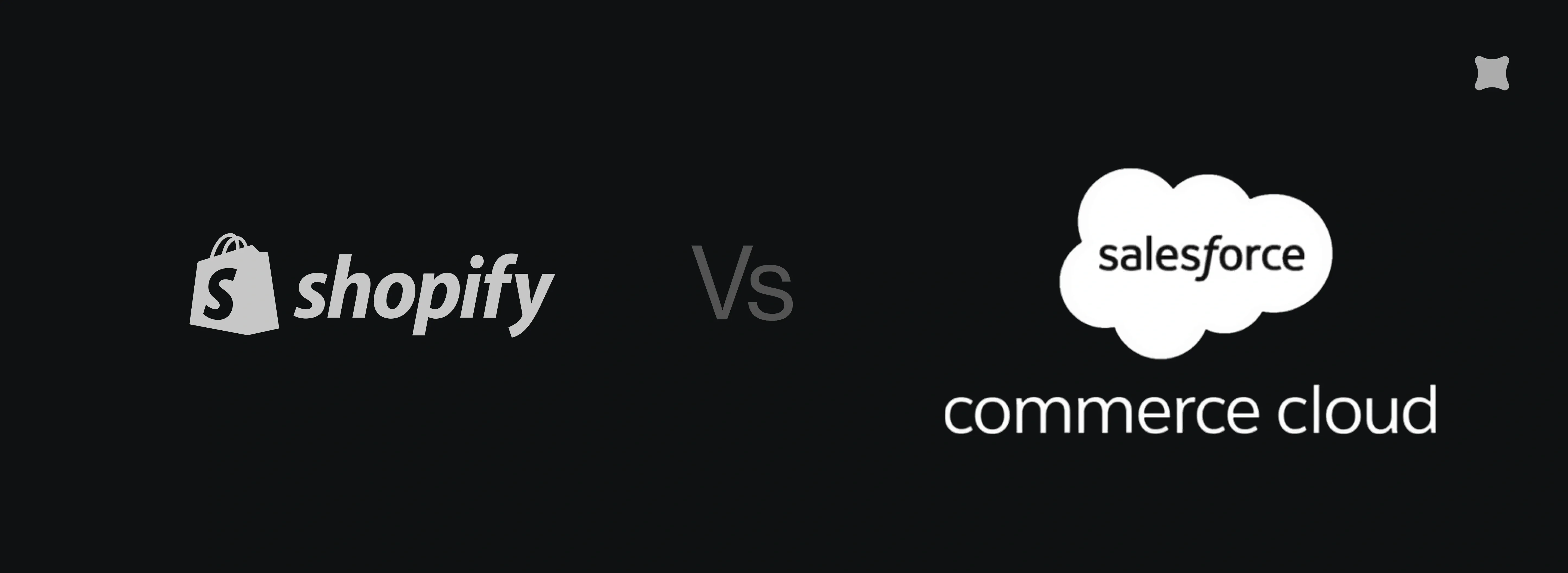
Evaluating platforms for your next phase of growth? Shopify and Salesforce Commerce Cloud will be on every shortlist. Both can power enterprise commerce—but their operating models diverge meaningfully as you scale. The result shows up in total cost of ownership (TCO), speed, and everyday simplicity.
According to the Shopify vs. Salesforce TCO comparison, Salesforce’s TCO is 54% higher on average than Shopify’s, with 14% higher platform costs, 6% higher operating costs, and 16% higher implementation costs. Shopify’s checkout also converts 36% better—a ~3.6% TCO offset (assuming 10% margin). See the infographic on page 1 and the breakdown on page 2 of the one-pager.
Salesforce typically incurs higher platform fees and a larger supporting stack (apps, integration overhead). Shopify’s managed platform compresses the stack and removes hidden “run” costs (hosting, patching, scaling), shifting spend toward growth work (merchandising, CX).
Brands launch 28% faster on Shopify than on Salesforce, on average. That agility compounds: promos, price tests, bundles, and market rollouts happen without upgrade projects or heavy DevOps.
Checkout is where roadmaps become revenue. Shopify’s checkout converts 36% better than Salesforce’s on average—treated in the study as a 3.6% TCO offset (at 10% margin).
Want the cost checklist?
Get the Shopify vs. Salesforce — TCO & Growth one-pager.
Salesforce’s flexibility often means more internal IT or partner hours to maintain legacy complexity and integrations (ERP, finance systems). Shopify centralizes storefront, checkout, payments, performance tooling—and POS for omnichannel—so you run the business, not the infrastructure.
MZ Wallace: after moving from Salesforce to Shopify Plus, TCO down 64%; “spending less and driving sales more efficiently.”
If you require deep, bespoke framework control and are staffed to own ongoing customization and integration complexity, Salesforce can fit. For most growth-minded teams, Shopify’s lower TCO + faster launch + higher conversion is the pragmatic path.
We include the migration checklist (data, SEO, redirects, QA gates) in the one-pager.
As a Shopify Plus Partner, we help you assess fit, plan data/SEO/app parity, implement B2C/B2B, enable Shopify POS, train teams, and launch with confidence—turning the switch into a business upgrade, not just a tech project.
If your north star is speed to market, lower TCO, and a world-class checkout, Shopify is the faster growth vehicle. Salesforce can work for control-heavy programs—if you’re prepared to fund the complexity.
Download Shopify vs. Salesforce — TCO & Growth (instant PDF via email).

