01
Home
02
Services
03
Cases

04
About Us
05
Careers
06
Blog

07
Contact Us
01
Home
02
Services
03
Cases
04
About Us
05
Careers
06
Blog
07
Contact Us
Ask for a free consultation now

Leading the global partnerships strategy through building and scaling alliances across the Shopify ecosystem.
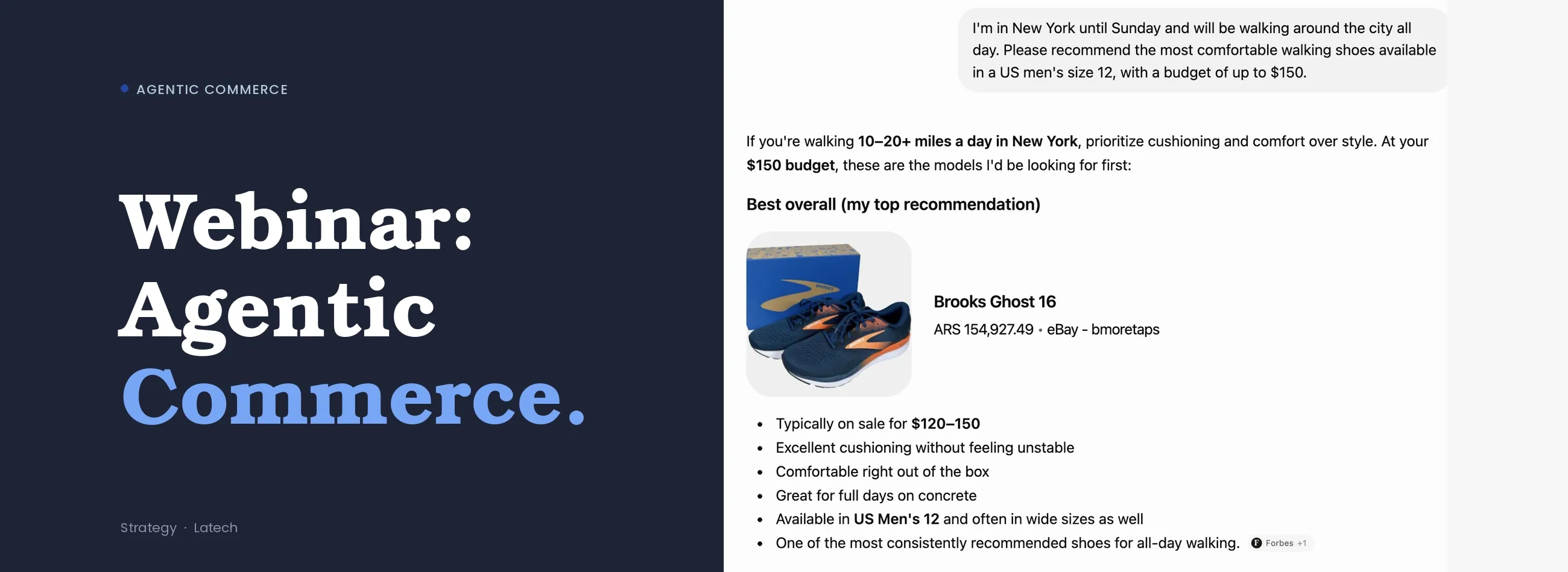
We recently ran a webinar with ecommerce leaders from Mexico, Colombia, Argentina, Uruguay, Chile and Peru. Sixty minutes, six countries, one topic that generates equal parts skepticism and FOMO.
Here's what I take away from the conversation: there's massive noise between what's being said about agentic commerce, what's actually happening in Shopify stores today, and what's still vendor promise.
After the discussion, my reading has three layers.
AI traffic to Shopify stores grew 8x in a year. AI-referred orders, 13x. ChatGPT has 880 million monthly users. AI traffic converts 50% better than organic in 23 of 25 categories. 60% of searches are zero-click, 77% on mobile.
These aren't projections. It's measurable flow today.
And what's interesting isn't just the volume. It's the compression of the purchase journey. A traditional user made 3 to 5 searches, visited 8 to 12 pages, bought days later. A user with AI does all the research in one conversation and arrives at the site ready to buy. The product page receives a pre-qualified buyer, not someone still evaluating.
That changes what your product page needs to deliver. Less exploration, more confirmation.
The infrastructure is already in place. Shopify and Google co-developed UCP (Universal Commerce Protocol), the open standard that lets any AI agent discover, interact with, and transact with any brand.
On March 24, 2026, 5.6 million Shopify stores were activated inside ChatGPT, Copilot, Google AI Mode and Gemini. In a single day. Without opt-in. Shopify Catalog structured every merchant's data automatically and exposed it to the agents.
If your brand sells on Shopify, you're already inside the agent, whether you know it or not.
What's still maturing is buying behavior. Today most users discover through AI and complete the purchase on the brand's site. We're at Level 1 of autonomy: assisted discovery, human decides. Level 2 (one-click checkout inside the agent) exists but isn't the default yet. Levels 3 and 4 (agents that buy autonomously, manage restocking, run the business) live in pilots, not production.
The infrastructure you build for Level 1 is the same infrastructure that positions you for Levels 2 and 3.
Any vendor selling autonomous agents running businesses in production today is confusing demo with product. The technology exists. Consumer trust to delegate, legal responsibility over each agent action, deep integrations with internal systems, economic models between brand and buying agent: none of that is close to resolved.
The question that kept coming up in Q&A was one: What do I do this week?
Short answer: a lot. Five concrete fronts, all actionable before Friday.
First, measure the AI traffic you're already getting. Shopify Analytics lets you filter by Referral Channel: ChatGPT, Perplexity, Copilot, Claude. Compare conversion, AOV and revenue per session against your organic. You'll find AI converts better, almost always.
Second, audit the quality of your product data (GEO, Generative Engine Optimization). Four questions: Are all product fields complete? Are specs in metafields or only in HTML? Are you collecting and displaying reviews? Is product data consistent across your store, Mercado Libre and other marketplaces? Start with your top 20 SKUs by revenue.
Third, speak the structured language of crawlers on your site. The same description "Timeless design sofa, crafted with premium materials" is beautiful for humans and opaque for agents. Structured data (category, dimensions, materials, pet-friendly, kid-friendly, delivery) is parseable, searchable, and recommendable.
Fourth, behavioral personalization instead of static rules. Instead of "if buys X, show Y," a recommendation engine that reads navigation and cart in real time. Start with high-ticket categories. Pilots show +40% revenue on average.
Fifth, off-site authority. Only 30% of the signals AI uses come from your site. The other 70% come from mentions in Reddit, category forums, independent reviews, media, and Google Business. Identify the 5 communities where a mention of your brand generates the most AI authority.
Now, doing all five fronts by hand is slow. That's why at the close of the webinar we demoed Latech Core live, our own agent tool for Shopify brands. It doesn't just identify SEO and GEO gaps in your catalog. It executes them: applies changes, fills metafields, refreshes descriptions. Everything traced and reversible.
One last thing. These actions don't replace SEO investment. They compound on it. Organic SEO remains the base on which AI builds context.
The capture window is open now. Brands that structure this in the coming weeks will capture position when the rest of the stack finishes landing. Those that wait will pay more to recover ground.

