01
Home
02
Services
03
Cases
04
About Us
05
Careers
06
Blog

07
Contact Us
01
Home
02
Services
03
Cases
04
About Us
05
Careers
06
Blog
07
Contact Us
Ask for a free consultation now
Quotes in minutes, not days.
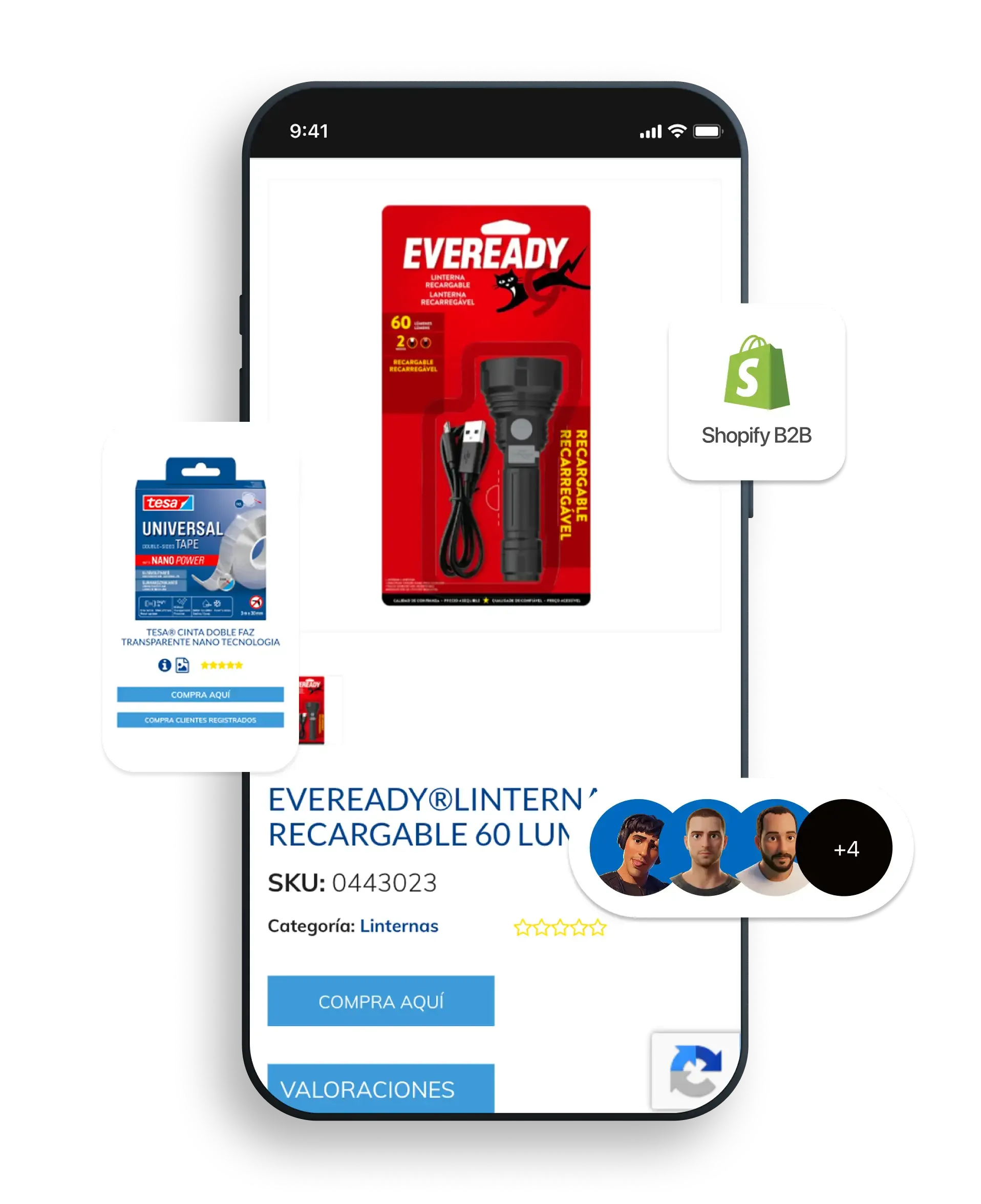
A 25-year wholesale channel, now running 24/7 self-service.
ADEPAC is a Chilean distributor with more than 25 years importing and representing leading hardware and household brands (La Gotita, Poxipol, WD-40, Tesa, Duracell, Drano) for a B2B network of hardware stores across Chile.
The operation was 100% offline: stores could only order when the rep visited. Pricing lived in spreadsheets, every order was re-keyed by hand into Softland, and the customer had no view of stock, catalog, or account balance.
A B2B store on Shopify Advanced with a proprietary Latech theme, SparkLayer as the wholesale rules engine, and Latech Bridge integrating catalog, stock, orders, and account balance with Softland in real time.
ADEPAC isn't a business that started online. It's a Chilean distributor that has spent more than 25 years importing and representing leading hardware and household consumer brands (La Gotita, Poxipol, WD-40, Tesa, Duracell, Klerat, Drano) and bringing them to neighborhood hardware stores across Chile. Its natural channel was always the hardware retailer: small and mid-sized stores that historically bought through a team of field sales reps, with quotes, orders, and stock inquiries always going through human contact.
Behind the operation, a Softland ERP centralized sales, stock, and account balances. All the information existed, but it stayed inside.The data never reached the hardware store. The model worked, sustained by the sales force, but it couldn't keep pace with the channel's growth or the new expectations of a customer who already buys online in other categories and expected the same from their wholesale supplier.
The most visible symptom was total dependence on the field rep: the hardware store could only order when it got a visit. There was no way to place an order on a Saturday, browse the catalog at night, or grab a one-off deal without waiting for the human sales cycle. The channel had a ceiling set by the sales team's calendar.
Underneath sat a structural problem. Price lists and conditions by customer type weren't unified in one place, which created inconsistencies, rework, and dependence on the rep's judgment to quote. The catalog had no digital storefront: offers and promotions traveled in spreadsheets or printed catalogs, and the customer never saw real availability. And every order taken on the route was re-keyed manually as a purchase order in Softland, adding hours of administrative work and risk of error. The hardware store had no way to check its account balance, its available credit, or its history: everything came down to ask and wait.
The key to the project was an architecture decision: connect Shopify to Softland as a single operation, not two systems watching each other from a distance. At Latech we proposed an end-to-end B2B architecture designed so the hardware store could operate autonomously without breaking the commercial rules that already lived in the ERP.
The store was built on Shopify Advanced with a proprietary Latech B2B theme, designed for wholesale buyer behavior: browsing by brand, fast reordering, a focus on SKU and units, and a storefront that finally exposes catalog, offers, and promotions permanently. On top of that we added SparkLayer as the B2B engine instead of Shopify's native B2B, to handle price lists by customer type, volume discounts, minimum orders, and differentiated rules, centralizing in one place the pricing logic that used to live scattered across spreadsheets and rep judgment.
The piece that tied it all together was Latech Bridge, our integration SaaS built to connect any ERP to Shopify and SparkLayer. For ADEPAC it syncs catalog and stock in real time from Softland, and sends ecommerce orders automatically to the ERP as purchase orders, eliminating the double manual entry and its associated errors. It also connects credit and account-balance data, so the hardware store sees its account status inside the store and operates on its real commercial terms, not generic ones. With the operation solved, we added Klaviyo to open the retention cycle: automated flows, reordering, B2B cart abandonment, and communication segmented by customer category.
The project's risk hypothesis was clear: the traditional hardware retailer would resist the change. The opposite happened. 90% of the hardware channel adopted the platform, a figure that far exceeded the initial expectation. The digital channel today processes 270 B2B orders per month, all flowing into Softland with no manual re-entry.
The Shopify ↔ Softland integration via Latech Bridge went live in production, syncing catalog, stock, orders, and customer account balance across a catalog of 188 SKUs. The hardware store shifted to quoting and buying in 24/7 self-service, no longer dependent on the rep showing up and with the channel open outside business hours too. And all of this was achieved in 3 months from kickoff to go-live of a complete B2B operation with ERP integration. What used to be a quote that took days of back-and-forth with the rep is now resolved in minutes.

