01
Home
02
Services
03
Cases

04
About Us

05
Careers
06
Blog

07
Contact Us
01
Home
02
Services
03
Cases
04
About Us
05
Careers
06
Blog
07
Contact Us
Ask for a free consultation now
B2B foodservice equipment with the performance of a modern DTC.
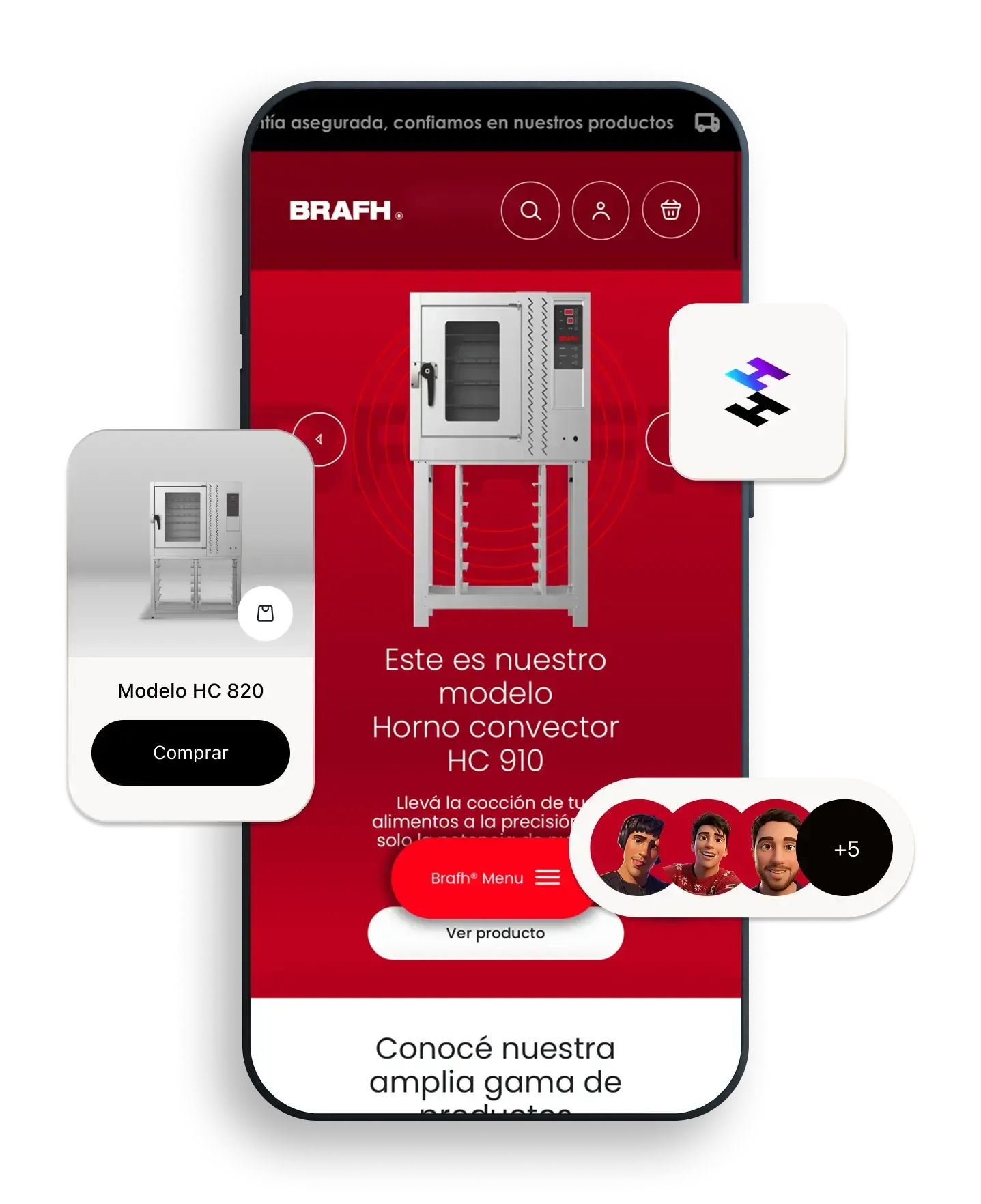
A regional operation. A frictionless digital experience.
BRAFH is a leading foodservice equipment provider based in Argentina, with commercial coverage across Uruguay, Chile, and Brazil. It serves a B2B network of hotels, restaurant chains, distributors, and turnkey projects.
The digital channel ran on a custom PHP platform that no longer matched the pace of the business: LCP above 5 seconds, B2B flow with friction, and rigidity to expand regional coverage without intervening critical pieces of the codebase.
Migration to Shopify with a headless frontend on Hydrogen + Oxygen. The B2B logic was preserved, the buying experience was redesigned for recurring clients, and LATAM coverage was unified on a single store with modern DTC performance.
BRAFH didn't start as a digital business. It's a foodservice equipment operation with years of relationships built directly with its clients — hotels, restaurant chains, distributors — across Argentina, Uruguay, Chile, and Brazil. The online channel came later, as a response to a concrete need: wholesale clients who wanted to quote, compare, and place orders without waiting for the next email-and-call cycle with their account rep.
The first version worked. It was built on custom PHP and handled the basic catalog operation for as long as the digital channel needed to gain weight in the business. But the business moved faster than the platform could follow. LATAM coverage expanded, the catalog grew, active B2B clients arrived with different expectations. What had been enough stopped being enough.
The first symptom was performance. Pages that took more than 5 seconds to load, especially on mobile — where the B2B operator checks pricing during a site visit or while comparing suppliers on the go. But speed was only the visible indicator of a deeper problem: the platform had become rigid to any change.
Adding a new country to the coverage meant intervening critical pieces of the codebase. Adjusting terms by B2B client required back-end work. Keeping the catalog consistent across Argentina, Uruguay, Chile, and Brazil meant parallel processes that introduced inconsistencies. The site worked, but every move the business made cost the technical team before it reached the customer.
The decision was architectural before it was cosmetic. Migrating the catalog to Shopify gave operational stability and freed the team from maintaining base infrastructure. But the frontend asked for more: a fast, fluid, configurable experience capable of serving serious B2B without feeling heavy.
The frontend was rebuilt on Hydrogen + Oxygen, Shopify's official headless stack. Server-side rendering, edge computing, and a clean separation between the commerce engine and the experience layer. This made it possible to design a B2B flow with authentication, client-specific terms, order history, and extensive catalog navigation without compromising site speed. The technical argument was simple: if DTC fashion brands use headless to sell T-shirts faster, there is no reason a B2B industrial operation with higher tickets should run slower.
The site relaunched three months after kickoff. LCP dropped from 5 seconds to 2.2 — a 56% improvement that showed up first on mobile and then in every engagement metric. But the number that mattered to the business was a different one: conversion rate on the digital channel rose 65% across the same catalog and the same clients.
The 270 active B2B clients moved to a single platform covering Argentina, Uruguay, Chile, and Brazil, with 140 SKUs live and a wholesale buying flow that no longer required workarounds. The new infrastructure didn't just solve the previous one's problems: it enabled a different way to think about the B2B channel, with speed, regional consistency, and room to grow without rewriting.

