
01
Home
02
Services
03
Cases

04
About Us

05
Careers
06
Blog

07
Contact Us
01
Home
02
Services
03
Cases
04
About Us
05
Careers
06
Blog
07
Contact Us
Ask for a free consultation now
When the product is premium, the storefront has to follow.
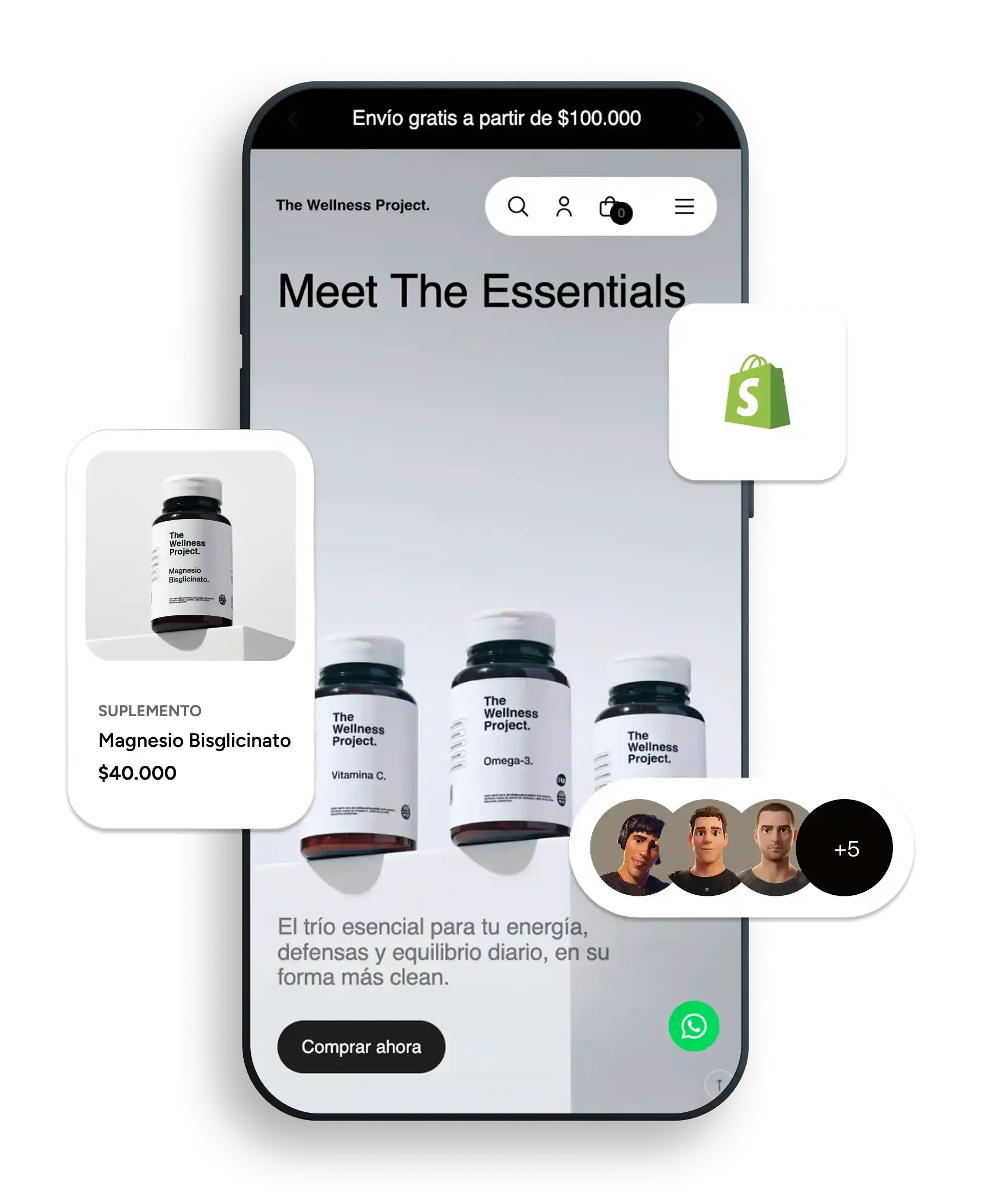
+113% conversion rate in the first month post-migration.
The Wellness Project is a premium Argentine supplement brand, co-founded by rugby star Pablo Matera (Los Pumas), Milagros Saguier, and Iván Bronenberg, with a focus on quality, transparency, and scientific backing.
The brand operated on a WordPress storefront that no longer kept pace with its growth or premium ambition: it limited conversion, the mobile experience, and integration with the logistics and payment operation.
Built the ecommerce from scratch on Shopify, with LATECH leading both design and development, with Mercado Pago and ShipNow integrations, and a mobile-first experience designed for the brand's premium positioning.
The Wellness Project was born from a clear observation: in Argentina, there is a gap in genuinely traceable, transparent, scientifically backed premium supplements. The brand was built by three complementary profiles — Pablo Matera, a professional rugby player with more than 15 years on Los Pumas, Argentina's national rugby team; Milagros Saguier, a Health Coach certified by the Institute for Integrative Nutrition (IIN); and Iván Bronenberg, a Strategy Director with a long entrepreneurial track record.
The proposition was built around three declared pillars —quality, transparency, and science— and an initial line called The Essentials: high-purity Omega-3 with IFOS certification, Vitamin C 1000 mg, and Magnesium Bisglycinate. A brand designed for a consumer who pays for the difference.
Like many brands starting out, The Wellness Project's first ecommerce was built on WordPress. It served to validate the initial operation and let the brand start moving in the market, but it quickly became clear that the platform couldn't sustain the pace or the ambition of the project.
The symptoms were recognizable: a conversion rate below what the product justified, a mobile experience that didn't keep up with the weight of traffic coming mostly from social, and limitations to integrate with the logistics and payment operation at the scale the brand was starting to require. The product was premium. The ecommerce wasn't yet.
The decision was to migrate to Shopify and rebuild the ecommerce from scratch. But the scope was broader than a technical migration: LATECH took charge of both the complete design and the implementation, ensuring that the visual experience, the buying flow, and the technical architecture all responded to the brand's premium positioning.
The stack was built on Shopify with mobile-first focus, given that more than 90% of traffic arrived from mobile. The integrations were designed to sustain the real operation of the business: Mercado Pago as the local payment gateway and ShipNow as the logistics layer for distribution across Argentina. The catalog was structured around the hero product —The Essentials Pack— without losing visibility of the individual SKUs, in line with the brand's commercial strategy.
Forty business days later, the site was in production.
The relaunch on Shopify didn't need a warm-up period. The conversion rate more than doubled: it went from 1.3% on WordPress to 2.77% in the first full month on the new platform — a 113% jump. That improvement isn't explained by the platform change alone: it's explained by an ecommerce designed specifically to serve a premium buyer who enters from mobile, decides fast, and needs confidence.
The impact transferred to volume without sacrificing average order value: monthly orders grew 27% and monthly revenue grew 33%, while AOV remained stable. The growth didn't come from offering less — it came from converting better.
The channel strategy also found validation: roughly 40% of the month's revenue came from Instagram, confirming the bet on supporting the launch through the founders' personal audience. And the new-customer cohort from the previous month showed 20% retention into the second month — a healthy early signal for a monthly-replenishment product.

